
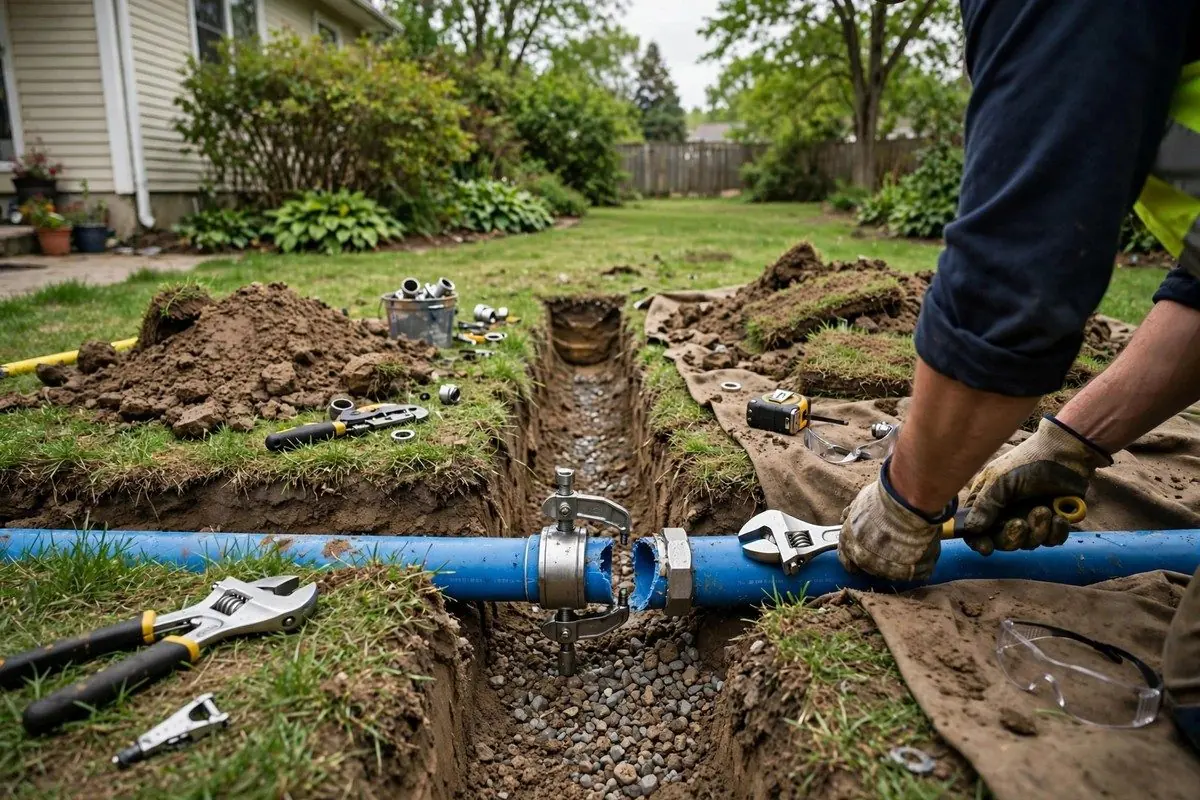
No water, or too much of it in the yard
A failed service line shows up two ways. Either the taps go dry or run weak, or water surfaces where it should not, usually a soft patch in the lawn or a wet strip along the driveway. Both mean urgent work, and our 24/7 line is open now.
While you wait, close the house main so you know the leak is not inside, stay off soft ground over the line, and keep kids and pets away from any hole that is forming. Take a photo of the wet spot and note when you first saw it.
Water is surfacing in the yard right now
These steps tell you which side of the problem you are on.
- Close the main valve where the line enters the house.
- Check the meter. If the dial keeps turning with the house main closed, the leak is outside the house.
- Look for water bubbling from the ground, a sunken patch, or a stream along the street. Note where it is.
- If the water is clearly at or before the meter, call the city line below. If it is past the meter, call us.
- Call (206) 864-6558 and tell the dispatcher what the meter does and where the ground is wet.
Who owns which stretch of pipe
The City of Mountlake Terrace provides water inside city limits. It supplies nearly 2 million gallons of drinking water per day to more than 6,000 homes and businesses. The city's mains run under the street and the meter sits at the property edge.
Where the city's responsibility ends and yours begins can differ by property, so ask City Public Works at 425-670-8264, Monday to Friday, 7 a.m. to 3:30 p.m., before anyone digs. After hours use the Snohomish County non-emergency line at 425-407-3999.
Once it is established that the break is on your side, we handle everything from the meter to the house. If the break is the city's, we do not dig in its line, and we will say so on the first call.
Trench or trenchless: how the options compare
Neither method is better for every line. The right one depends on the pipe, the depth and the surface above it.
| Method | How it works | When it tends to fit | Trade-off |
|---|---|---|---|
| Spot repair | Dig to the break, cut out the bad piece, join new pipe | One localized failure in a pipe that is otherwise sound | Next failure can show up elsewhere on an old line |
| Open trench replacement | Dig the full run and lay new pipe | Pipe is old, mixed material, or in poor shape end to end | Lawn, paving and landscaping need restoring |
| Trenchless pull | Pull new pipe through the old path from two access pits | Clear path, cooperative soil, desire to protect surfaces | Not every line can take it, and access pits are still needed |
| Reroute | Run a new line along a different path | Old path is blocked by a structure or pavement | New path may need more permission and planning |
From wet yard to working line
Here is the order we follow so nothing is replaced that did not have to be.
Confirm the leak is on your side
The meter test and the ground tell us whether the failure is yours or the city's.
Locate the break
We trace the line and listen along it to pick the spot, so we dig once. See leak detection for buried lines.
Decide repair or replace
We look at the pipe material and condition, and explain the options with a clear price before work starts.
Repair, test and restore
New pipe goes in, pressure is tested, and we flag what the yard needs afterward.
The line material nobody wrote down
Homes from different decades have different service lines. Older lines may be lead, galvanized steel or copper, while newer ones are often plastic. If you are not sure what is under your yard, say so when you call.
A line of unknown material that has already leaked once is a good candidate for full replacement. Patching one failure on a worn pipe tends to move the next one down the line. If the lead question is on your mind, ask us about it and we explain what to check and what the options are.
Signs the service line is the problem
These clues sit outside the house, which is why many owners miss them.
- Meter turns with everything off. This is the clearest sign when the house main is closed.
- Soft, sunken or green ground. Water saturates soil and feeds grass faster over the break.
- Low pressure at every fixture. A leak before the house steals flow from all taps.
- Dirty or sputtering water. Air or silt can enter a damaged line.
- Hissing at the meter box. Pressurized water escaping makes a steady sound.
- A sudden jump in the water bill. The city bills every other month, so a leak can run a full cycle before the statement shows it.
What changes the price of a water line repair
Line work is the hardest to price from a phone call because the pipe is out of sight.
A short spot repair and a full meter-to-house replacement are different jobs.
Deeper pipe and tough digging take longer and raise labor.
Lawn, planting beds, driveway or a walk all affect how the line is reached.
Trench and trenchless need different equipment and access.
If the exact spot is unknown, tracing it is a separate step before the repair.
Insurance varies. Homeowners policies usually cover sudden accidental damage, and usually do not cover wear, corrosion or gradual leaks, and some do not cover the yard line at all. Check your own policy. We give a clear price before work starts, so call (206) 864-6558 for your number.
Repair the line alone or repipe everything
Some owners fix the service line and discover the pipes inside are just as tired. If the house is old, ask us whether it makes sense to do both while crews are on site. A new line feeding old galvanized pipe inside still gives you rusty water and weak pressure.
That conversation leads to whole-house repiping, which is a bigger project but one that is handled once. If you only need the line, we do only the line. It is your choice.
We answer 24/7 at (206) 864-6558 and set up a same-day visit when available.
Water line questions, one at a time
Yes. The dispatch line is open 24/7, and same-day appointments are available when the schedule allows. If water is surfacing in the yard at midnight, close the house main, call us, and we will tell you what to do until a crew can start.
The line on the city side of the meter belongs to the city system, and the stretch from the meter to your house generally belongs to the property owner. Where one ends and the other begins is not the same on every property. Ask Public Works before any digging starts, and we will take it from there.
Close the main valve at the house. If the meter dial still turns with everything off and the main closed, water is escaping before the house. Soggy ground, a sunken strip or lush grass over the line point the same way.
Sometimes. Trenchless methods pull a new pipe through the old path from small access pits. They depend on the pipe's condition, depth and what sits above it. We explain which approach fits your line before anyone starts digging.
Tell us when you call, and we check the material where the line enters the house and at the meter. Lead, galvanized steel, copper and plastic are all possible in different eras. Replacing a mystery line is a conversation worth having before it fails.
That is usually the landlord or property manager's job, depending on the lease. Tell them right away, and we can speak with them about what the line needs.
Standards and sources
These public references sit behind the rules and checks this page mentions.