
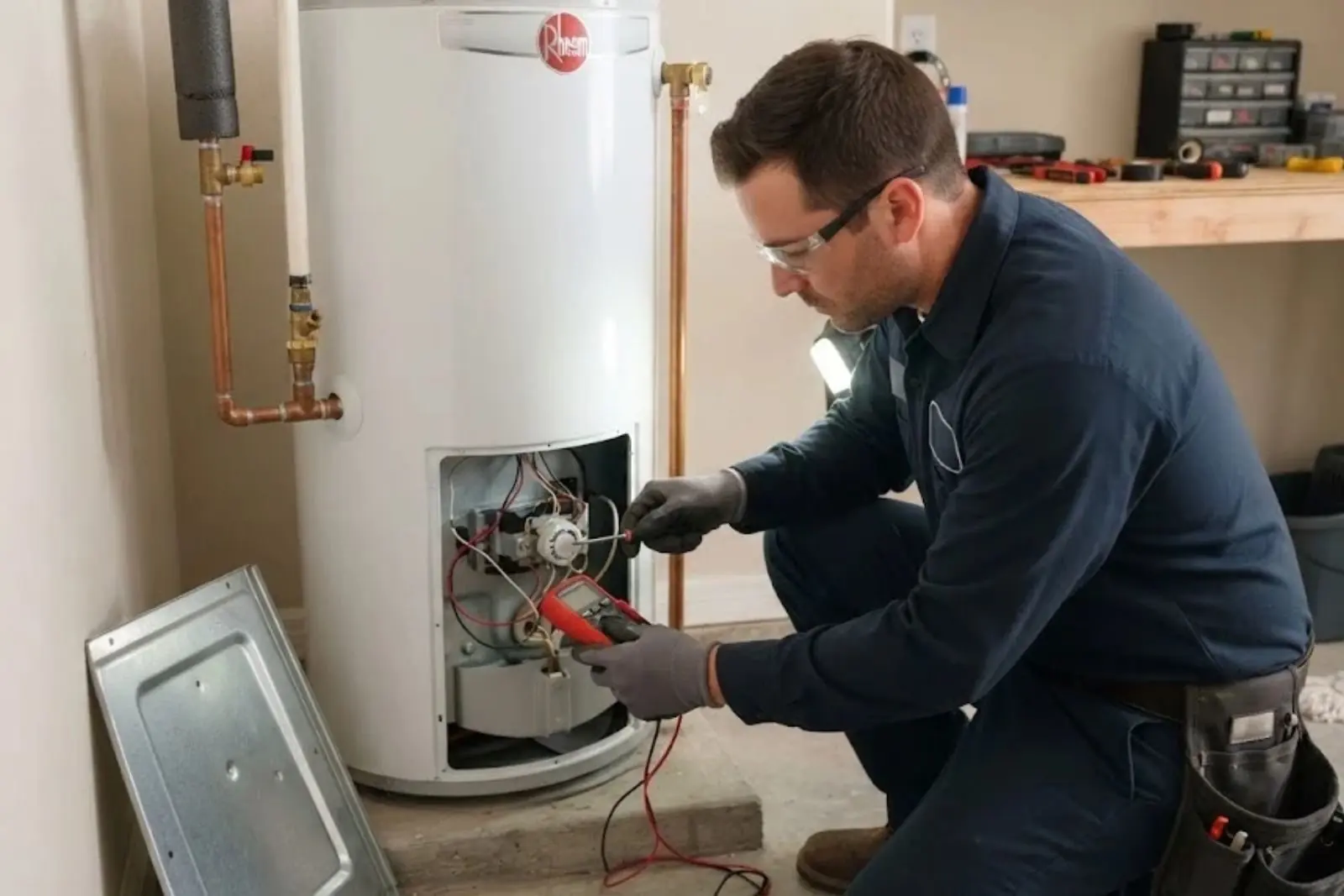
Water pooling under the tank right now
If water is spreading from your heater, you do not need to wait for a repair to limit the damage. We run a 24/7 emergency line, and while you wait for the visit there are a few things you can do to keep the leak small.
Gas units come first. If you smell gas, leave the building and call the gas utility or 911 before anything else. We do not service gas lines, and a gas smell is never a reason to stay inside.
- Close the cold-water supply valve on the pipe entering the top of the tank. Turn the handle clockwise until it stops. A lever handle closes when it sits crosswise to the pipe.
- On an electric unit, switch off its breaker only if the panel area is dry and you can reach it safely. If water is near the panel or outlets, stay away and tell the dispatcher.
- On a gas unit with no gas smell, turn the gas control knob to the off or pilot setting. Do not touch the burner compartment.
- Place a bucket or a wet vac under any drip, and lift stored boxes and carpet off the floor. Keep cords out of the water.
- Call (206) 864-6558 and tell us the fuel type, where the water comes from and roughly how old the tank is.
What the symptom usually means
Most water heater calls fall into a handful of patterns. This table is a starting point, not a diagnosis, because a technician has to test the unit to be sure.
| What you see | Common cause | What happens next |
|---|---|---|
| Water at the base, tank shell wet | Corroded tank wall or failed bottom seam | Replacement. A leaking shell cannot be patched |
| Drip from the pipe at the side or top | T&P valve, supply fitting or nipple | Repair is often possible once the part is tested |
| Puddle under a drain valve | Worn drain valve or sediment holding it open | Replace the valve and flush the tank |
| No hot water, gas unit | Pilot out, thermocouple worn, gas control fault | Test the flame sensor and the control, then repair |
| No hot water, electric unit | Tripped high-limit switch, dead element or thermostat | Meter the elements and replace the failed one |
| Rumbling or popping from the tank | Sediment hardened on the bottom | Flush, then check the anode rod and heating parts |
| Rotten-egg smell from hot water only | Reaction at the anode rod | Inspect the rod and sanitize the tank |
Describe the leak or the symptom and we will give you a clear price before work starts. Call (206) 864-6558.
Fixable leak or finished tank
Water on the floor is the most common reason people call, and it is also the most misread. A wet tank is not always a failed tank. Condensation on a cold-water pipe, a loose union on the top, or a drip from the T&P valve discharge pipe can all look like a leak from the heater itself.
The test is where the water starts. If it runs from a fitting, a valve or a pipe connection, a repair usually makes sense. If it seeps from the tank's jacket or collects under the insulation, the steel liner has failed. No part can fix that, and we will say so rather than sell you a repair that will not hold.
Callers often find water in a garage, closet or attic instead of a basement. The tank drains toward whatever is lowest, so the puddle can sit well away from the heater. Following the damp line back to the heater is part of the diagnosis.
No hot water: pilots, elements and thermostats
A heater that makes no hot water at all is a different job from a leaker. On a gas unit, the pilot flame heats a thermocouple that tells the gas valve it is safe to open. When that sensor wears out, the pilot goes out and the burner never fires. Replacing a thermocouple is a small repair on a unit that is otherwise sound.
Electric units heat with two elements, one near the top of the tank and one near the bottom. If the top element fails you get no hot water. If the bottom one fails you get a short supply that runs cold fast. A tripped high-limit button, the small red reset on the upper thermostat, can also cut power, and it usually trips for a reason.
If you smell gas near a gas heater, do not try to relight anything. Leave the building, call the gas utility or 911, and call us once you are safe. We do not work on gas supply lines, but we will check the heater once the utility clears the building.
What a repair visit covers
Every visit starts with finding the actual fault, not swapping parts and hoping. Here is what we typically check.
- The leak path. We dry the area and trace the water to its source before we name a repair.
- The T&P valve and discharge pipe. A valve that weeps or a pipe that is capped or kinked is a safety problem and gets addressed first.
- Drain valve and supply connections. Worn washers, loose unions and corroded nipples are common sources.
- Anode rod. This sacrificial rod protects the tank steel. A spent rod is one reason older tanks fail early.
- Heating parts. Thermocouple, igniter and gas control on gas units, elements and thermostats on electric ones.
- Venting and combustion air. Gas units need a clear flue and enough air, so we check for backdrafting and blockage.
What changes the price of a water heater repair
Two repairs that look alike can cost very different amounts. These are the things that move the number, and we explain which ones apply to your unit.
A thermocouple, a drain valve and a gas control valve are very different parts with very different labor.
Gas, electric, power-vent and hybrid heat pump models each have their own parts and test steps.
A tank in an open utility area is quick to reach. One in a tight closet, attic or crawlspace takes longer.
Rusted fittings and seized valves can turn a small repair into a larger one, and sometimes into a replacement.
A same-day or after-hours visit is priced differently from a scheduled one.
Homeowners policies usually cover sudden accidental damage, such as a tank that bursts and floods a room. They usually do not cover wear, corrosion or a slow leak. Check your own policy. We give a clear price before work starts, so call (206) 864-6558 for your number.
When repairing stops making sense
A tank that has reached its mid-teens, shows rust at the connections and keeps needing parts is telling you something. Each repair buys a little time on a steel shell that is wearing out from the inside. When the shell fails, the repair money is gone along with the tank.
Our rule of thumb is simple. If the failed part is separate from the tank and the tank is sound, repair it. If the tank itself is leaking, or it is old and has several problems at once, look at a replacement water heater instead. We lay out both paths in plain terms and do not push either one.
If you are curious about switching styles, a tankless unit heats on demand and has no tank to rust through. It is a bigger change than a repair, so read about tankless water heater service before deciding.
Strapping, quakes and finding your door
Mountlake Terrace sits in earthquake country, and a full water heater is heavy and tall. Straps or a seismic kit anchor the tank to the wall studs so it cannot tip and tear the gas or water lines loose. If your tank stands loose in a garage or closet, ask us to check the straps while we are there.
Geography matters for dispatch too. The city sits along Interstate 5, with interchanges at 220th Street SW, 236th Street SW and SR 104, and SR 99 forms the western edge. When you call, give the dispatcher your cross street and which side of I-5 you are on, so we can find the right door fast.
Before we arrive
A few minutes of preparation makes the visit smoother and helps us give you an accurate price.
Move boxes, shelves and laundry so the technician can reach the tank and its valves.
The data plate on the side lists the model, fuel type and capacity. A photo helps.
Write down when the leak or the cold water started and whether anything changed first.
Locate the cold supply valve on the heater and the main shutoff for the house.
Error codes and newer units
Newer heaters report faults on a small display. A code usually names a sensor, an igniter, a blocked vent or a condensate drain that has backed up. The code tells us where to look. It does not tell us the part has failed, so we test before we replace anything.
Water heater repair questions we hear most
Yes. The emergency line is open 24/7, including nights, weekends and holidays. A dispatcher asks where the water is coming from and whether the unit is gas or electric, then books a same-day visit when one is available.
It depends on where the water comes from. A dripping drain valve, a loose supply fitting or a weeping T&P valve is a repair. Water seeping through the tank shell or the bottom seam means the steel has failed, and that tank needs replacing.
If you smell gas at any point, leave the building and call the gas utility or 911 before you call us. With no smell, a pilot that keeps going out usually points to a worn thermocouple or a draft problem. Repeated relighting only hides the cause, so call us instead.
Tell your landlord or property manager first, because most leases make the owner responsible for the water heater. If they authorize the visit, we can talk to the property manager directly. If the lease says otherwise, we give you a clear price before any work starts.
Age matters, but condition matters more. A tank in its teens with rust at the fittings, sediment noise and a wet pan is near the end. A younger unit with one failed part is usually worth repairing. We explain both options and let you decide.
On an electric unit, a failed lower element or thermostat is common. On a gas unit, a dirty burner or a weak thermocouple can do it. Heavy sediment also reduces how much hot water the tank holds, so a short flush and part check often settles it.
Yes. Codes on newer gas and hybrid heat pump units usually point to a sensor, igniter, vent or condensate problem. We read the code, test the part it names and tell you what the fix involves before we start.
Standards and sources
These public references sit behind the rules and checks this page mentions.