
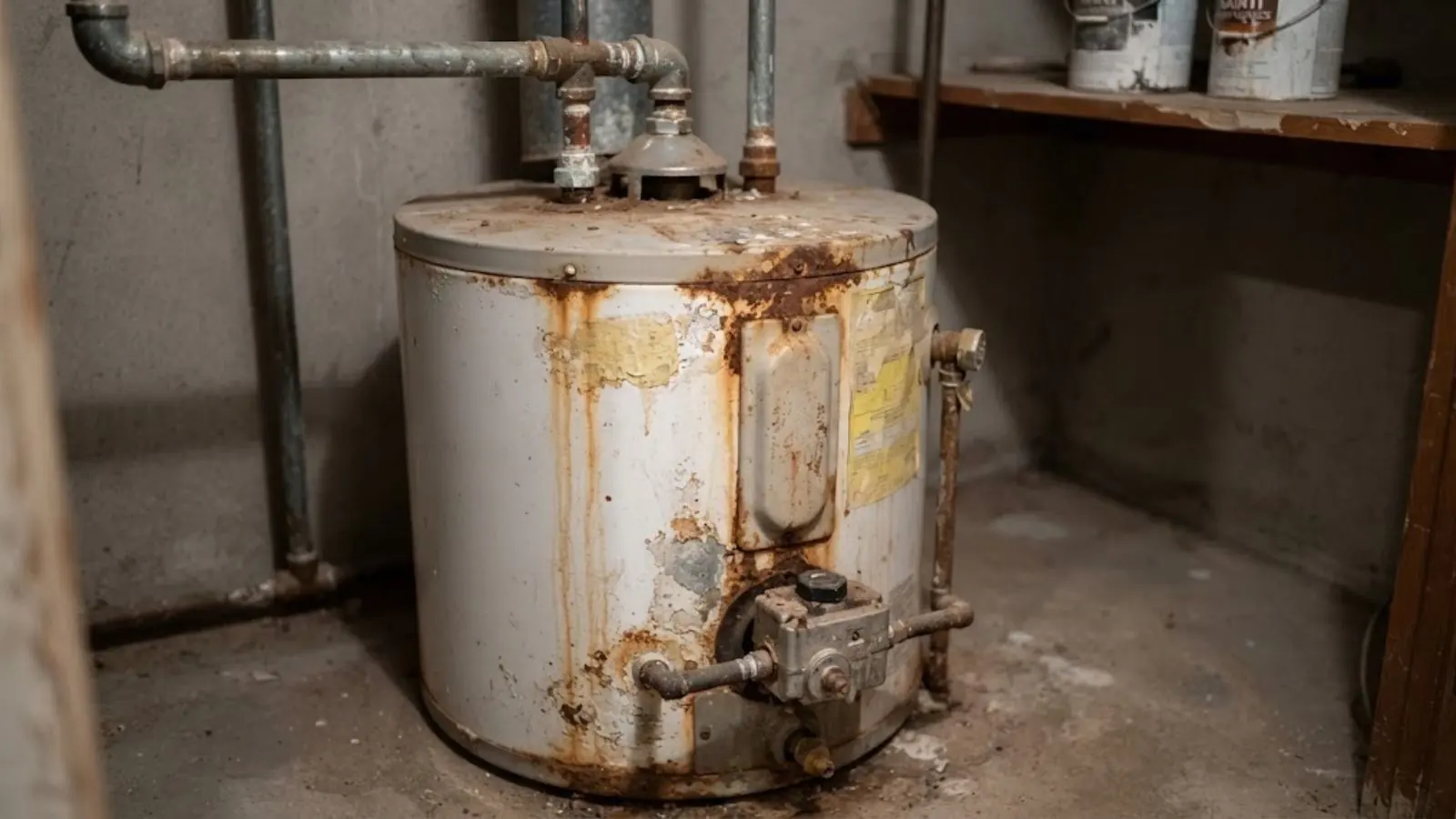
Replace now or repair first: a five-minute test
Before you decide anything, find out where the water is coming from. Dry the tank with a towel, then watch for the first bead of water. If it forms at a pipe fitting, a valve or the relief line, you may be looking at a repair, and a repair visit is the cheaper first step.
If the bead forms on the tank body, or the insulation under the jacket is soaked, the steel is done. A tank that has lost its liner will keep leaking, and it can let go all at once. At that point, replacement is the only sound answer, and the sooner the old tank is off the supply line, the less water ends up in your floor.
A tank flooding the room
A failed tank can empty into a closet, garage or basement quickly, so the first minutes matter. Our 24/7 line is staffed, and while we line up your replacement you can stop most of the damage yourself.
If you smell gas near a gas unit, leave the building and call the gas utility or 911 first. Do not turn anything on or off inside the building.
- Shut the cold-water supply valve above the tank. If it will not turn, close the main shutoff for the house.
- On an electric tank, switch off its breaker only if the panel is dry and you can reach it safely. Do not step in standing water to get to it.
- On a gas tank with no gas smell, turn the gas control to off.
- Put a bucket or wet vac under the leak and keep power cords and extension leads out of the water.
- Move anything valuable off the floor, then call (206) 864-6558 and tell us the fuel type, the tank size and where it sits.
Tell the dispatcher the fuel type and where the tank sits, and we will walk through your options. Call (206) 864-6558.
Gas, electric or heat pump: what changes
The fuel decision drives most of the work on replacement day. This table covers the main differences.
| Unit type | What it needs | What to expect |
|---|---|---|
| Gas tank | Gas supply, flue to outside, combustion air, T&P valve and discharge pipe | The venting must be sound. A same-fuel swap is usually the simplest |
| Power-vent gas | Gas supply, electric outlet for the blower, PVC vent through a wall | Venting is more flexible, but the outlet and vent route need checking |
| Electric tank | A dedicated circuit and breaker sized to the unit | Quick to swap if the circuit is sound. Wiring faults get fixed first |
| Hybrid heat pump | Circuit, airflow space, a condensate drain and enough room | Highest change from gas. We check room and drain route before pricing |
| Tankless on-demand | Gas line or heavy electrical, venting, a condensate path | A different project. See our tankless water heater page |
How a replacement day unfolds
Replacement is a sequence, and knowing it helps you plan the day.
Shut down and drain
We shut off water and fuel, then drain the old tank to a floor drain or the outdoors.
Disconnect and remove
Supply lines, vent and gas or electric connections come off, and the old tank is carried out.
Set the new unit
We place the tank on a level base or pan, fit new connectors and connect the T&P valve discharge.
Connect, vent and test
Fuel, venting and power go on, and we test for leaks, draft and temperature before we leave.
Strap and walk through
We strap the tank, show you the shutoffs and explain how to set the temperature.
Older homes and the tanks inside them
Mountlake Terrace began as postwar housing. Compact two-bedroom houses went up in 1949 and the years after, and many were later renovated or added onto. That history matters for a water heater swap, because a utility closet built for a small tank may hold only a certain size, and a later addition may have put the heater in a different spot than the original plan.
In practice, that means we measure the closet door, the ceiling height and the venting path before we promise a model. An old house may also have a legacy drain or old supply piping near the tank, and we check those while the water is off. If the connections to the heater are corroded galvanized steel, tell the technician before the visit so they bring the right fittings.
Ask for a pipe-material check along with the swap, since a new tank connected to tired piping can leak at the first joint that moves.
The permit question
People ask whether a replacement needs a permit, and the honest answer is that rules vary. The City of Mountlake Terrace permit center lists building, electrical, mechanical, plumbing and fire permit types, with application checklists for plumbing. Which one applies to your swap depends on what changes.
Our advice is to ask the city permit center before the work starts. A fuel switch, a new vent route or a new circuit changes the picture compared with a plain like-for-like swap, so describe the full scope when you call. We can tell you what we plan to do so you can describe it accurately.
What changes the price of a water heater replacement
Two houses with the same tank size can get very different prices. Here is what moves the number.
A standard gas tank, a power-vent model and a hybrid heat pump differ in equipment cost and in the work needed to install them.
Moving from gas to electric or heat pump adds circuit work, and moving the other way adds gas piping and venting.
A rusted flue, an undersized circuit or a corroded gas connector must be fixed for the new unit to run safely.
Stairs, tight closets and attics add time. Haul-away should be named in your price.
A permit, a new expansion tank, a drain pan or seismic straps each add parts and labor when they apply.
Homeowners policies usually cover sudden accidental damage, like a tank that bursts and floods a room. They usually do not cover wear, corrosion or a slow leak. Check your own policy. We give a clear price before work starts, so call (206) 864-6558 for your number.
What to settle before we set a new tank
A few decisions made ahead of time keep the day short.
- Fuel type. Stay with what you have or switch, and say so on the call.
- Household hot water use. More people and bigger tubs call for a larger tank or a different style.
- Where the unit will sit. Keep the same spot unless a move is needed for venting or access.
- A pan and drain. In a closet or upper floor, a pan with a drain line limits damage from the next leak.
- Expansion tank and straps. A closed plumbing system needs an expansion tank, and the tank should be strapped to the wall.
- Old unit removal. Confirm that haul-away is part of the price you are given.
- Landlord or HOA approval. If you rent or live in a condo, get the green light before the day.
After the swap: what a new connection should do
A new heater should run without drips at any fitting, without a smell of gas and without a hissing T&P valve. If you see water at a union or supply line in the first days, close the cold supply valve and call the company that did the work. That usually points to a connection that needs another quarter turn, not a tank defect.
If you ever smell gas near a gas heater, leave and call the gas utility or 911 before you call anyone else.
Same-day and after-hours replacement
When a tank fails in the evening, the first goal is to stop the water, and the second is to get hot water back. We take replacement calls on the 24/7 line and book same-day appointments when they are available. Whether we can set a tank that same night depends on the unit and the site, and the dispatcher will tell you honestly what is possible.
If your home is near Interstate 5, SR 99 or the Town Center, give the cross street and the nearest interchange. If you bought a unit yourself, read about water heater installation. We also serve neighbors to the south through our Lynnwood plumber page.
Replacing a water heater: your questions
Yes. The 24/7 line takes calls at any hour. For a tank that is actively flooding, we help you shut the water off over the phone, then book the first same-day or next available visit for the replacement.
Often yes, but it is a bigger job than a like-for-like swap. Electric and heat pump units need the right circuit and breaker, and a heat pump unit also needs space, airflow and a condensate drain. We check all of that on site before we price it.
Ask for removal to be named in your price before you agree, so there is no surprise on the day. We state what is and is not included when we give you the number.
Permit rules vary, so ask the city permit center before the work starts. The city lists plumbing, mechanical and electrical permit types, and it can tell you which one covers your swap.
Tell your landlord or property manager right away, since the water heater is usually the owner's responsibility under a lease. We can speak with the manager and give them a clear price before work starts. Your lease decides who pays.
Close the cold supply valve and call the company that did the work, since a loose union or fitting is a workmanship issue. If that was us, call (206) 864-6558 and we will come back and look at the connection.
Water seeping from the tank shell or the base is the clearest sign. Rust streaks, rumbling from sediment and repeated part failures on an older unit point the same way. We confirm it on site before you commit.
Standards and sources
These public references sit behind the rules and checks this page mentions.