
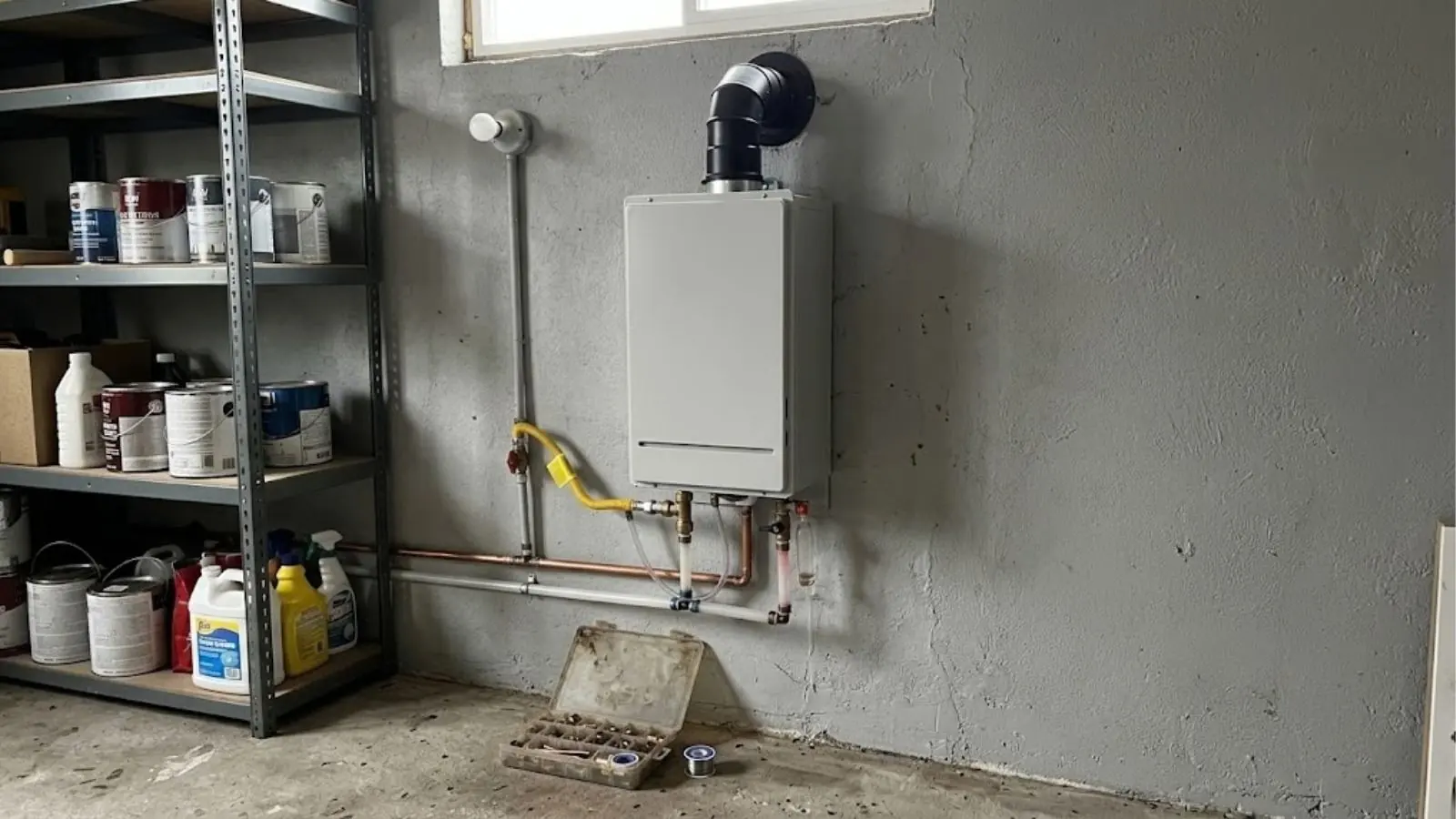
Will a tankless heater fit your house?
A tankless heater heats water as it flows, so it has no tank to fill, rust or flood. The tradeoff is that it needs a lot of fuel or power all at once. A gas unit may need a larger gas line than the tank it replaces. An electric unit may need heavy wiring your panel cannot spare.
That is why we want to see the site before giving a price. We look at the gas meter and line, the venting route, the electrical panel and a place for the condensate to drain. If a tank swap does not make sense, we say so, and a conventional tank stays a fair option.
What an annual tankless tune-up checks
A yearly visit finds small problems before they become a no hot water call.
- Error history. Past codes show repeating faults, such as flame or flow problems.
- Heat exchanger scale. We check how much scale has built up and whether a flush is due.
- Inlet filter screen. A clogged screen cuts flow and triggers shutdowns.
- Vent pipe and terminations. Joints should be tight, sloped properly and clear of blockage.
- Condensate line. On condensing units, a blocked drain stops the unit.
- Ignition and flame sensor. Dirty sensors cause lockouts and cold-water bursts.
- Temperature and flow. We test output at a tap to confirm the unit performs.
Tell us the brand, the code or the symptom, and we will explain what a service visit looks at. Call (206) 864-6558.
Flush and descale: what it is and why it matters
Water carries dissolved minerals, and heating it deposits them as scale on the inside of the heat exchanger. Scale acts like insulation, so the burner works harder, the water comes out lukewarm and the unit may overheat and shut itself off.
A flush uses a pump, two hoses and a descaling solution to circulate through the exchanger, followed by a clean-water rinse. It is a service job, not a replacement job. If you were told the only option was a new unit, ask for a flush and an inspection first.
Mineral content varies between water supplies, so ask your water provider for its report if you want to know how fast scale may form in your unit.
Symptoms and likely causes on a tankless unit
This table lists the patterns we see most often. A technician must test the unit to confirm.
| Symptom | Likely cause | What we do |
|---|---|---|
| Water goes cold in the middle of a shower | Flow too low, scale or a dirty sensor | Clean the screen, flush the exchanger and test flow |
| Error code on the display | Ignition, flame, vent or flow fault | Read the code and test the part it points to |
| Rumbling or kettle noise | Scale on the heat exchanger | Descale and rinse |
| Beeping alert | A warning tied to a stored code | Check the code history and vent |
| Water at the base of the unit | Loose fitting, failed internal part or condensate leak | Find the source before choosing a repair |
| Burnt wiring smell or scorched thermocouple wire | Overheating, wiring fault | Shut it off and call. We inspect before restart |
Winter, wet season and earthquake country
Puget Sound has a wet season from fall to spring and occasional winter freezes. A tankless unit hung on an outside wall, or one with exposed supply lines in a garage or crawlspace, can freeze, and a vent that fills with water or debris can fault the unit. Check the supply lines and vent termination before the first cold snap.
The region is also earthquake country. A wall-mounted unit should be fixed firmly to studs, and the gas connector should have enough slack to flex. We look at both during a service visit.
If you smell gas near any gas unit, leave and call the gas utility or 911 first. Then call us.
What changes the price of tankless service or a swap
A flush is a different project from converting a tank. These factors apply.
A flush, a repair, a tune-up and a full swap are priced very differently.
A tankless unit often needs a bigger gas line, which adds piping.
New vent pipe, a wall penetration and a drain for condensate each add work.
Electric units need heavy circuits, and condensing gas units need power for the fan.
Tight locations and corroded isolation valves add time.
Homeowners policies usually cover sudden accidental damage, not wear, scale or a slow leak. Check your own policy. We give a clear price before work starts, so call (206) 864-6558 for your number.
Code, permits and who is doing the work
Washington adopts the 2021 edition of the Uniform Plumbing Code, published by IAPMO, with state amendments. For a new tankless unit or a fuel change, permit rules vary, so ask the city permit center before the work starts.
You can also verify any plumber you consider on the state L&I Verify tool before work begins. For installation planning, see water heater installation. For other problems with a hot water system, water heater repair covers tanks.
Time and availability
Tankless service calls are rarely emergencies, but a unit that quits in winter feels like one. Our dispatch line runs 24/7, and we book same-day appointments when they are available. Tell the dispatcher the brand and any code and we will plan the visit.
Tankless water heater questions
It depends on your water and how heavily the unit is used. Mineral scale builds inside the heat exchanger, and the maker's manual gives an interval. We check scale on site and tell you what your unit needs.
Yes. A flush circulates a descaling solution through the heat exchanger and then rinses it. Many units that run hot, noisy or slow are fixed this way. If the exchanger is damaged beyond that, we tell you before replacing anything.
The code points to a sensor, ignition, flame, vent or water-flow fault. It is a clue, not a verdict. We test the part the code names and explain what we find before any repair.
A leak can come from a fitting or an internal part, rumbling often means scale, and beeping is usually an alert tied to a code. Shut the water and gas supply to the unit if it leaks, and call us.
Tell your landlord or property manager first. In most leases the heater belongs to the building. We can talk to the property manager and give a clear price before work starts.
It depends on gas line size, the venting route, available electrical and the space. We look on site before giving a price, because a unit that does not fit your setup wastes money.
Yes. We evaluate what is worth repairing and what is not. A very old unit with a failing heat exchanger may not justify the work, and we say so plainly.
Standards and sources
These public references sit behind the rules and checks this page mentions.