
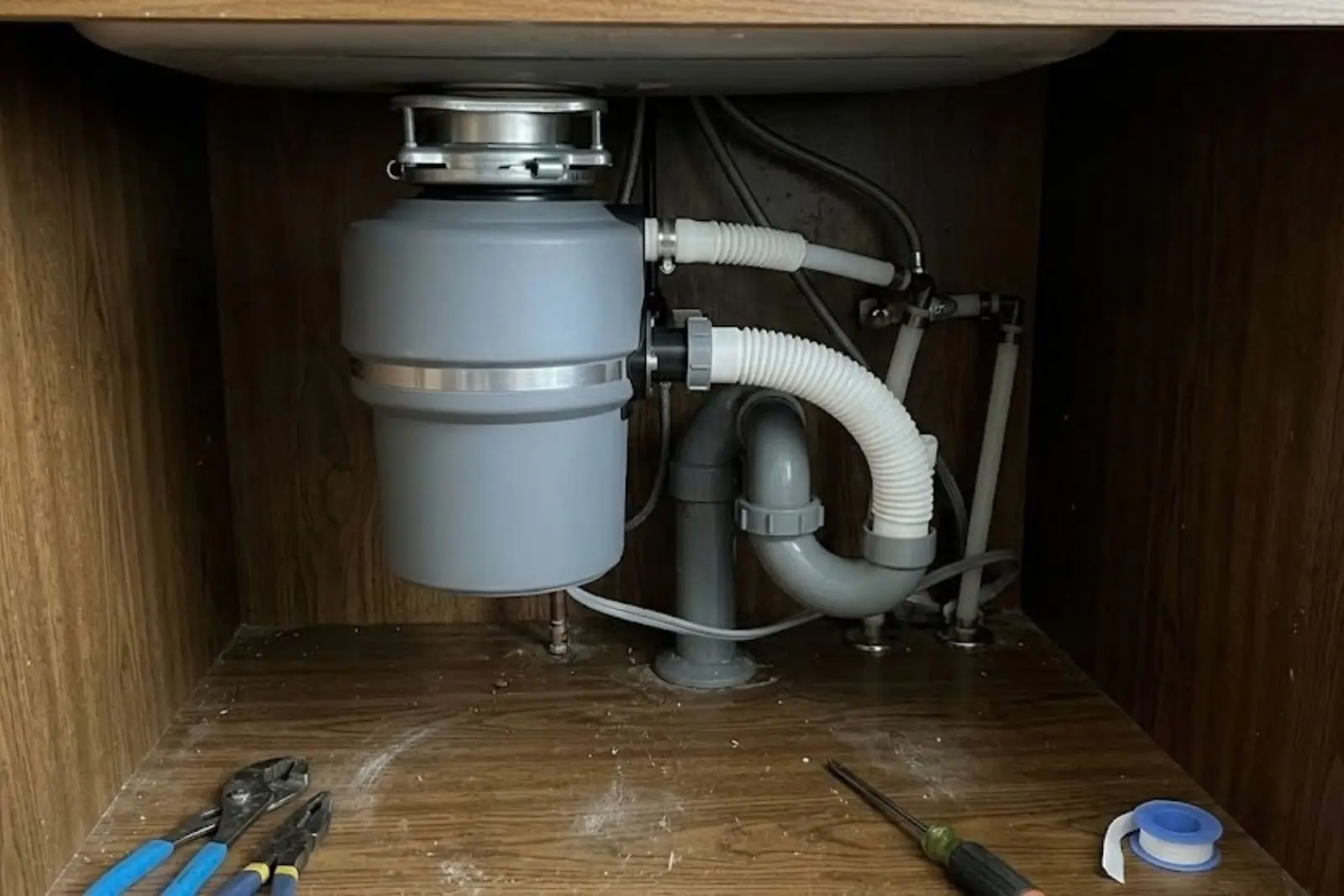
Does it hum, stay silent or leak? Start there
Those three sounds point to three different repairs, and you can tell them apart in a minute. We answer the phone 24/7, so if the kitchen is flooding or the unit has come off the sink, call now and keep the water off while you wait.
A hum with no spin means the blades are stuck, often from a bone, a fruit pit or a bottle cap. A silent unit has either tripped its overload or lost power, or the motor has burned out. A leak is a seal, a seam or a drain connection letting go.
Do the safe checks first. Turn the wall switch off, and then look under the sink to see where the water originates.
Before you touch it, what to do and what to leave alone
A disposal can injure you or shock you if you treat it casually.
- Switch it off, then unplug it. Most units plug in under the sink. If yours is wired directly, turn off the breaker only when the panel is dry.
- Never put your hand in the drain. Use tongs or pliers to lift out an object you can see, and only with the power off.
- Try the hex socket underneath. A hex wrench in the center hole on the bottom lets you rock a stuck flywheel free. Then press the red reset button.
- Skip drain chemicals. They sit in the chamber, burn skin and can eat the seals.
- Stay clear of wet outlets. A leak that reaches a plug or switch is a shock risk. Leave it and call.
- Do not run it with a leak. Running a leaking disposal pushes more water out and soaks the cabinet floor.
Call (206) 864-6558 and tell the dispatcher whether it hums, stays silent or leaks, so we can bring the right parts.
Water pouring under the kitchen sink right now
If the disposal has come loose, split along a seam or burst a fitting, the cabinet fills fast. These steps limit the damage while we get to you.
- Switch the disposal off at the wall switch and unplug it.
- Close the two small valves under the sink, hot and cold, by turning them clockwise.
- If water keeps coming, close the main shutoff to the house.
- Empty the cabinet and set a bucket under the leak. Keep your feet out of standing water near outlets.
- Call (206) 864-6558 and tell the dispatcher what has failed.
Sound, symptom and the likely fix
This table pairs what you hear and see with the usual cause.
| What you notice | Likely cause | Usual fix |
|---|---|---|
| A hum, no spin | Jammed flywheel | Free it with the hex key, then reset |
| Silent, no hum | Tripped overload or no power | Reset, check outlet, replace if burnt |
| Leak from the bottom or side | Cracked housing or failed seam | Replace the unit |
| Leak at the top ring | Worn mounting gasket or sink flange | Reseat or replace the gasket |
| Leak at the drain pipe | Loose slip nut or cracked tailpiece | Tighten or replace the fitting |
| Sink fills and drains slowly | Blockage past the P-trap | Clear the line |
| Dishwasher water in the sink | Clogged dishwasher connection | Clear the inlet and hose |
What a disposal repair or swap involves
We shut off power and water first. For a jam, we free the flywheel and test the motor under load. For a leak, we find where the water comes from. A cracked housing means a new unit, while a loose mount or a dried gasket can often be repaired.
A replacement means releasing the mounting ring, lifting out the old unit, and seating a new one on the sink flange with fresh putty or a gasket. We reconnect the dishwasher drain, rebuild the P-trap and test with the water running.
A good hookup includes the dishwasher knockout plug, which must be removed on a new unit. Forgetting it is a common reason a fresh disposal does not drain the dishwasher.
What changes the price of disposal work
Disposal jobs run from a quick unjam to a full replacement. These factors set the price.
A reset or unjam is short work. A new disposal adds the unit, the install and the connections.
Motor size, sound insulation and feed type change what you buy.
A corroded trap, a cracked tailpiece or a worn dishwasher hose adds parts.
A disposal needs a switched outlet or a wired connection. A missing outlet needs an electrician.
An after-hours emergency differs from a same-day appointment when available.
A homeowners policy usually covers sudden accidental damage, such as a fitting that bursts and floods the kitchen. It usually does not cover wear, corrosion or a slow leak under the sink. Check your own policy. We give a clear price before work starts, so call (206) 864-6558 for your number.
Apartments and condos in Mountlake Terrace
The 2020 census counts roughly four in ten occupied homes in Mountlake Terrace as rentals, and apartments and condos were added in the 1970s, with newer buildings around Town Center more recently. In those buildings kitchen sinks often tie into a shared drain stack.
That changes what to do. If the sink backs up but the disposal runs, tell the property manager, since the blockage may be in a line they own. If your own trap and tailpiece are the problem, the repair can stay inside your unit.
Why disposals back up past the trap
The disposal grinds food into small pieces, but it does not carry them away. Water does that, and grease sticks to the pipe wall beyond the trap. Over months the scraps build up into a plug. Run cold water for a while after you grind, and keep fats out of the sink.
If the sink backs up even when the disposal is empty, the blockage is downstream and calls for drain cleaning rather than a new disposal.
Other kitchen and bath plumbing we handle
If the kitchen faucet drips while we are there, we can cover it with faucet repair. A running toilet in the next room is a separate call to toilet repair. For neighbors in the next city south, see our Lynnwood service page.
Call (206) 864-6558 and the dispatcher will sort out what you need.
Disposal questions people ask first
Yes. We staff the line at (206) 864-6558 24/7, and a disposal that is leaking into the cabinet, has come loose from the sink or has flooded the kitchen floor is a call we take after hours. Jams and hums that can wait go to a same-day appointment when available.
In an apartment, the disposal usually belongs to the building, so the landlord or property manager typically handles the repair. In a condo it depends on the association rules and your ownership documents. Tell the owner or manager in writing first.
If they want a plumber on site, we can speak with the property manager about the work and the price. A clog past the disposal may sit in a shared drain stack, which is a building matter.
A jam or a tripped overload is a cheap fix. A unit that leaks from the housing seam, has a seized motor or is rusted through is not repairable. We tell you which situation you have before we start, so you can decide.
Yes. We can install a unit you have already bought, hook up the dishwasher drain and rebuild the trap. We will tell you if something about it is wrong for your sink, such as a mounting that does not match.
Often the blockage sits past the P-trap, in the line the disposal feeds. Running the disposal harder only packs it tighter. Stop using the sink and call, because we may need a cable on the line.
Usually yes. The sink needs a standard drain opening, a nearby outlet or a new one installed by an electrician, and room under the sink. We check these on the call.
Grease, coffee grounds in bulk, fibrous peels, pasta and rice that swell, and bones or shells. These build up in the trap and the line beyond it, and they are a common reason a disposal and sink back up together.
Standards and sources
These public references sit behind the rules and checks this page mentions.