
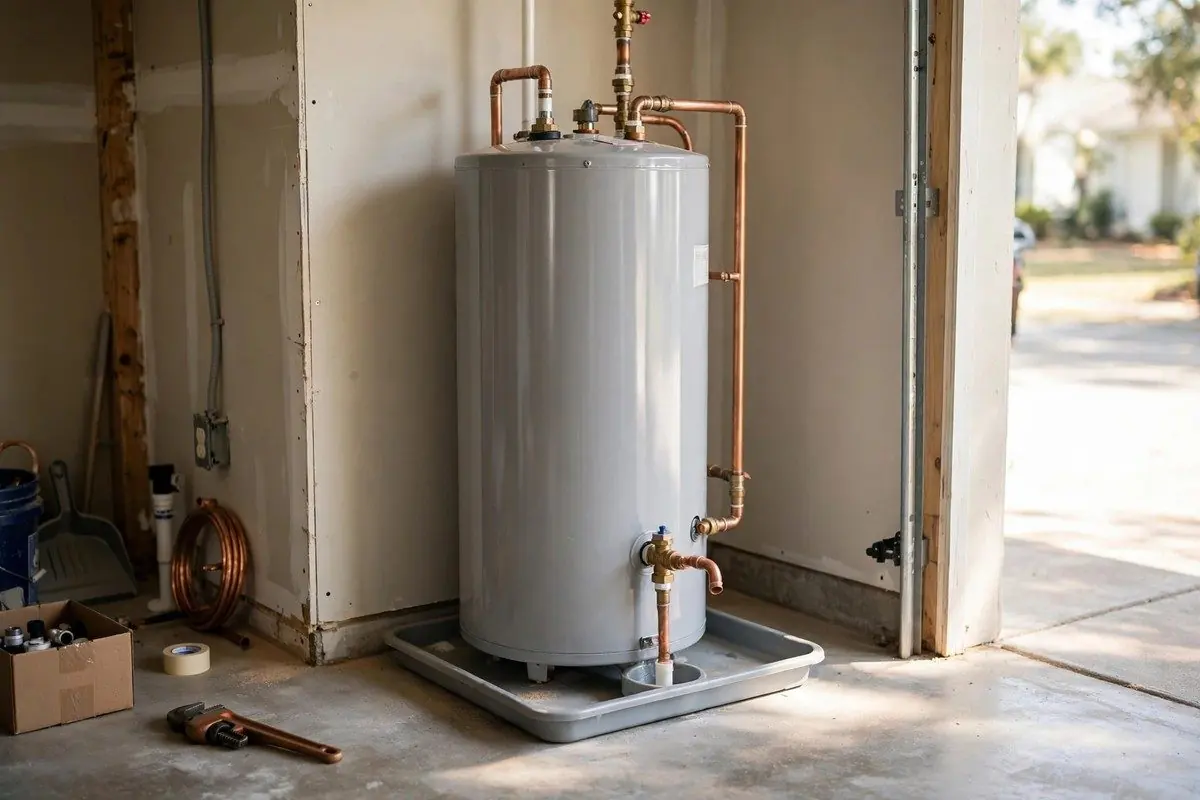
The short answer, and why it is not simple
A water heater looks like a simple swap, but it carries four risks in one box. It holds fuel or high-amp power, it sends exhaust out of the house if it burns gas, it stores a lot of hot water under pressure, and it sits on a floor that gets wet if anything fails. A person with good handyman skills can do some of these steps. Doing all four correctly takes plumbing and mechanical knowledge.
So the honest answer is that it depends on who the person is, what the unit burns and what your city requires. Treat the hire as a question about credentials and scope, not about price alone.
Where each part of the job carries risk
This shows the parts of an install and what can go wrong with each.
| Part of the job | What it involves | Risk if rushed | Who should verify |
|---|---|---|---|
| Gas connection | Shutoff, flex line, leak test | Gas leak or fire | Licensed plumber or gas pro |
| Venting | Draft hood, flue pitch, clearances | Exhaust in the home | Licensed plumber and city inspector |
| Electrical | Dedicated circuit, disconnect, bonding | Shock, fire | Licensed electrician |
| Relief valve and discharge | T&P valve and drain line routing | Scald or tank failure | Licensed plumber |
| Expansion control | Tank sized for closed systems | Pressure spikes, valve leaks | Licensed plumber |
| Permit and inspection | Application and final sign-off | Problems at resale or claims | Contractor, with the city permit center |
Call (206) 864-6558 and we will walk through gas, venting and electrical on your unit so you can compare any offer fairly.
How to check any contractor in five minutes
Washington L&I runs a public Verify tool at secure.lni.wa.gov/verify. Use it before you sign anything.
Ask for the business name or license number
A real contractor hands it over without hesitation. Search by business name, owner name, UBI or license number.
Read the registration and license status
The tool shows whether the business is registered and licensed and whether the status is active.
Check the trade credential
The same tool lists whether a tradesperson holds a credential in plumbing. Compare it to who actually shows up.
Look at workers' comp and bond
You can see workers' comp status and any lawsuits against a bond, which matters if someone is hurt on your property.
Look for citations
Safety or construction citations show on the record. Ask about anything you see.
Gas, electric and venting are the real dividing line
A gas heater connects to a rigid or flexible gas line, a shutoff and a vent that carries exhaust outside. If the flue pitch is off or a section is loose, carbon monoxide can enter the home. After the new heater is lit, someone should test the connection for leaks and confirm the draft is pulling the right way.
An electric heater draws a lot of power on its own circuit. A loose lug or an undersized wire runs hot inside a wall. If you smell gas at any point, leave the building and call your gas utility or 911 first, and only then call us. We cannot service gas lines.
The water side matters just as much
Even a clean gas or electric hookup can fail on the water side. The tank needs a temperature and pressure relief valve with a discharge pipe that ends in a safe spot, not capped or routed uphill. Supply connectors should be sound, with a shutoff on the cold inlet that actually closes.
If your home has a pressure reducing valve or a check valve on the main, thermal expansion has nowhere to go when the heater cycles. An expansion tank on the cold line absorbs it. Skipping that part is one reason a new tank drips from its relief valve a few weeks after install, and a pan under the tank limits the damage if a fitting weeps.
Ask these before you say yes
Any installer, handyman or plumber, should answer all of these plainly.
- Are you registered and licensed, and can I check that on L&I Verify?
- Who will pull the permit, and when will the final inspection happen?
- Which relief valve, discharge line and expansion tank does the quote include?
- How is the old tank removed and disposed of?
- Do you carry insurance, and can you show it to me?
- What happens if there is a leak a few days after the install?
- Will the written quote list every part and every task?
Insurance and resale are quiet costs
If unpermitted work causes a leak or fire, an insurer may look hard at who did the work and whether it was inspected. A missing permit can also surface when you sell. None of this means every handyman job is a problem. It means the paperwork matters as much as the water heater.
When a handyman fits, and when to call a plumber
A handyman fits if you want help moving the old tank out, hanging a drain pan, tightening an accessible fitting after a licensed pro finishes, or doing carpentry around the closet. Those jobs do not involve gas, venting or the electrical connection.
Call a licensed plumber when the job involves a fuel change, moving the heater, changing the vent path or adding an expansion tank. Our crew handles tank installs through water heater installation service and does the same for a unit that has failed, through replacement when the old tank is done. Call (206) 864-6558 for a clear price before work starts, and see our work in neighboring Lynnwood if you live south of us.
What this means in Mountlake Terrace
Washington adopts the 2021 edition of the Uniform Plumbing Code, published by IAPMO, with state amendments. You do not need to read it. What it means for you is that a water heater install is expected to meet a written standard for venting, relief valves and connections, so ask any installer which standard the job follows.
The City of Mountlake Terrace permit center at City Hall lists Building, Electrical, Mechanical, Plumbing and Fire permit types and publishes plumbing application checklists. Its page does not say when a water heater permit is required, so permit rules vary. Ask the city permit center before the work starts. Before you agree to a price, ask the installer whether a permit is part of it, and check the person on L&I Verify.
Handyman and water heater questions
That depends on the person's registration and license, and on what the work involves. We do not interpret state law for you. Look the person up on the Washington L&I Verify tool and ask the city permit center what applies to your job before the work starts.
A gas heater with weak venting can send exhaust into the home. A missing or wrong relief valve can leave a tank without pressure protection, and a loose connection can leak into a wall or floor. Each of these is a safety issue, not just a repair bill.
Policies differ, and most cover sudden accidental damage but treat poor workmanship and wear differently. Call your insurer and ask how unpermitted or unlicensed work is treated before you hire. Do not assume coverage.
Some owners do the work on their own home, but the same gas, venting, electrical and permit questions still apply, and a mistake can hurt people. If you are not sure about any of them, hand the job to a licensed plumber.
Permit rules vary, so ask the city permit center before the work starts. The permit center at City Hall lists plumbing and mechanical permit types, and the call takes only a few minutes. Ask whether the person you hire will pull the permit.
It should name the heater model and fuel, list venting, gas or electrical work, new connectors, a relief valve and discharge line, haul-away of the old tank, and who handles the permit. We give a clear price before work starts so you can compare line by line.
Standards and sources
These public references sit behind the rules and checks this page mentions.