
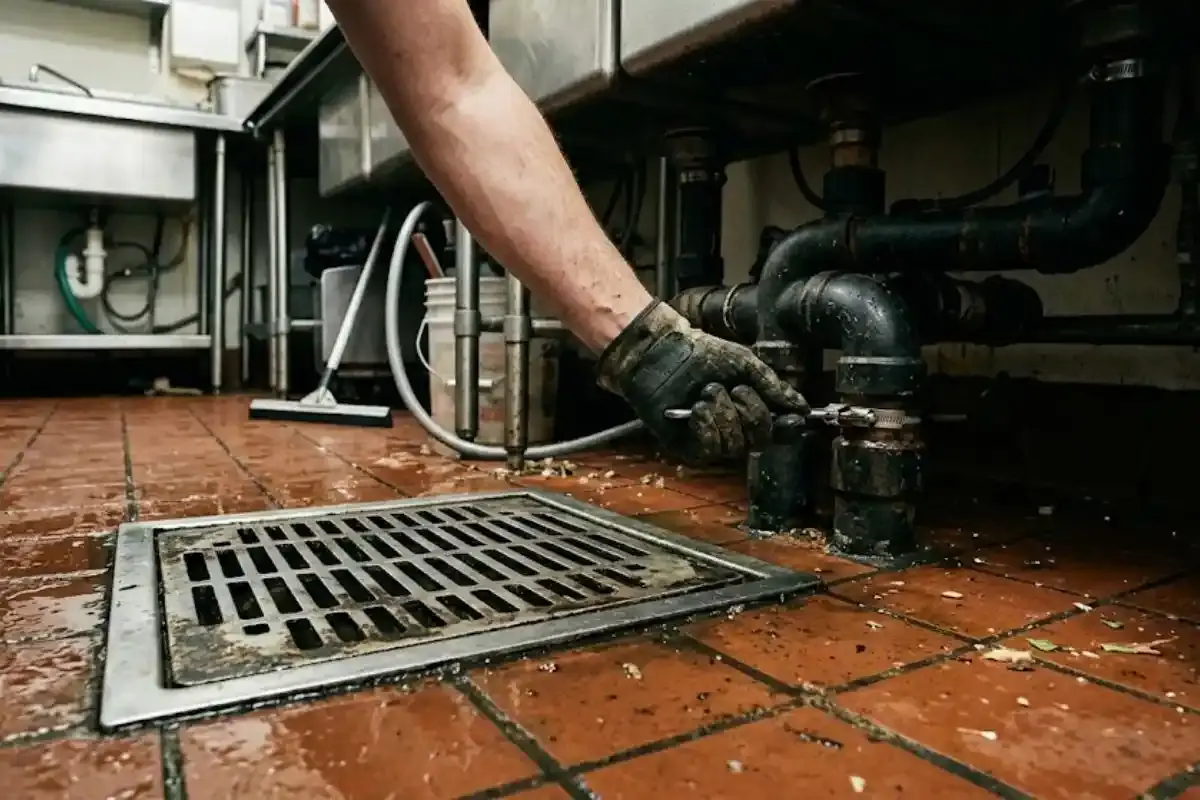
The back-room drain is rising and the doors open at nine
Business plumbing fails at awkward times, so our dispatchers answer 24/7. While you wait for a plumber, you can keep the damage down by stopping water going into the drain and moving stock off the floor.
A commercial drain carries more than a house drain does, and it often shares a line with other tenants. The first call is to learn whether the problem is local to your space or sits further down the building line.
Tell us what the space is used for, what fixtures are on that line, and where the water is showing. We use that to send the right parts and to decide whether we need a cable, a camera or a leak survey.
Overflowing floor drain or restroom flood right now
A flooded floor in a business creates a slip risk and can wreck stock. These steps buy you time.
- Stop water going into the drain. Turn off sinks, dishwashers and ice machines that feed it.
- Keep staff and customers out of the wet area, and put out signs.
- Shut the nearest fixture valves. If the flood continues, close the main shutoff.
- Lift stock, cords and paper off the floor if it is dry to do so.
- Call (206) 864-6558 and give the cross street, the space type and where the water is rising.
Call (206) 864-6558 and give the dispatcher your cross street, the type of space and where the water is showing up.
Which commercial problems we take and where else to turn
A clear answer helps you reach the right people on the first call.
| Problem | How we handle it | Other contact |
|---|---|---|
| Floor drain overflow | Cable or jet the branch and check the line | Building owner if the line is shared |
| Restroom backup or leak | Clear the line, repair fixtures and valves | Property manager for common restrooms |
| Continuing leak or utility notice | Leak survey and spot detection | Your utility for the meter itself |
| Water surfacing in a lot | Locate the leaking line and repair it | Building owner for lines under pavement |
| Grease trap pumping | Plumbing around the trap, ask about the rest | Hauler for pumping |
| Fire main or sprinkler leak | We do not service these | Fire protection contractor, or 911 |
| Standing water near electrical gear | We repair the plumbing source | Electrician or utility, or 911 if sparking |
Buildings with many fixtures behave differently
A public building like the Recreation Pavilion, with several pools, locker rooms and an indoor gym, shows how many fixtures one roof can hold. We do not claim to serve it. We use it to make a point about any large building. The more fixtures on a line, the more important a shutoff map becomes.
If you manage a space like that, find out where each zone can be shut off before something breaks. A plumber who can isolate one restroom is faster than one who has to close the whole building. Keep that list at the front desk.
What changes the price of a commercial plumbing call
Commercial calls vary more than home calls do. These factors drive the number.
Larger pipes and shared lines take longer and need heavier equipment.
Floor drains behind equipment, ceilings and locked mechanical rooms add time.
A single blocked drain differs from a leak survey across a whole building.
Same-day appointments when available during business hours differ from an after-hours emergency call.
We often need approval from the person responsible for the line before we start.
A commercial property policy usually covers sudden accidental damage, such as a pipe that bursts, and usually does not cover wear, corrosion or a leak that has run for months. Check your own policy. We give a clear price before work starts, so call (206) 864-6558 for your number.
How a commercial call runs
The goal is to get the water stopped, the cause found and the price agreed.
Describe the space
Tell the dispatcher the type of space, the fixtures involved and where the water is.
Contain the water
We talk you through the right valves and who to keep away from the area.
Find the cause
On site we trace whether the fault is in your space, in a shared line or at the supply.
Agree the price
You hear a clear price before work starts and approve it first.
Apartments, multi-unit buildings and the Town Center blocks
Town Center, between 220th and 236th Streets, has new apartment and mixed-use buildings, and those combine homes, shops and shared mechanical rooms in one structure. A leak in one unit can reach several units below it.
If you manage a building like that, the first question is whether the problem sits inside a unit or on a shared riser or stack. Tenants need a clear way to report water, and managers need a plumber who can talk to both. Water surfacing in a parking lot or a toilet backing up in one unit are typical examples.
What a facility manager can do before we arrive
A few steps cut the damage and speed up the job.
- Know your shutoffs. Find the main and the zone valves, and mark them.
- Keep a drain map. Note which fixtures feed which floor drain.
- Do not pry grates by hand. Steel covers are heavy and can crush fingers.
- Stay out of electrical rooms. Standing water near panels is a shock hazard, so call the utility or 911 if there is sparking.
- Keep an access contact. A person with keys for roof, boiler and utility rooms saves time.
Getting to you along the I-5 corridor
Interstate 5 runs through the city with interchanges at 220th St SW, 236th St SW and SR 104, and SR 99 is the western edge. When you call, name the nearest cross street and say if you are nearer the I-5 side or the SR 99 side. That helps the dispatcher place you.
We also dispatch to the neighboring city, see our Lynnwood page. For a business with a hidden loss, a leak survey is the usual first step, and for new fixture work see plumbing installation. You can also reach us at (206) 864-6558.
Questions from owners and facility managers
Yes. The line at (206) 864-6558 is staffed 24/7, and overflowing floor drains, failed restroom lines and active leaks are calls we take after hours. Jobs that can safely wait go to a same-day appointment when available.
We take service calls such as leaks, blocked drains, floor drains, restroom fixtures, water lines and multi-unit building problems. Large new-construction bids and specialty work, such as fire protection systems, are different, so call and ask. The dispatcher will say plainly whether the job fits.
Property managers and owners can call us directly, and we can coordinate with you on access and scope. Who pays depends on your lease and ownership documents, since a tenant fixture and a shared building line are not the same responsibility.
Tell your tenants to report problems to you first and keep a record of each call. We give a clear price before work starts, so you can approve it.
Pumping a trap is hauling work, usually done by a vacuum truck. Our plumbers deal with the pipes around the trap, such as the inlet and outlet lines and the drain behind it. Ask the dispatcher about your trap, and we will say what we can do and what to send elsewhere.
Keep people away from the wet area, shut off any fixtures feeding that drain and do not pry the cover with your hands. A heavy grate is a hand-injury risk. Call and we will tell you how to stop water going in until a plumber is there.
A notice often means the meter shows flow when the building is quiet. We can trace the leak with a leak survey, and the findings tell you whether it is inside the building or on the supply line. See our leak detection page for how that works.
Fire protection systems are a separate trade. If anything is burning, call 911. For a leaking sprinkler riser, shut the system valve if you are trained to, and call the building's fire protection contractor and the fire department's non-emergency line.
Standards and sources
These public references sit behind the rules and checks this page mentions.