
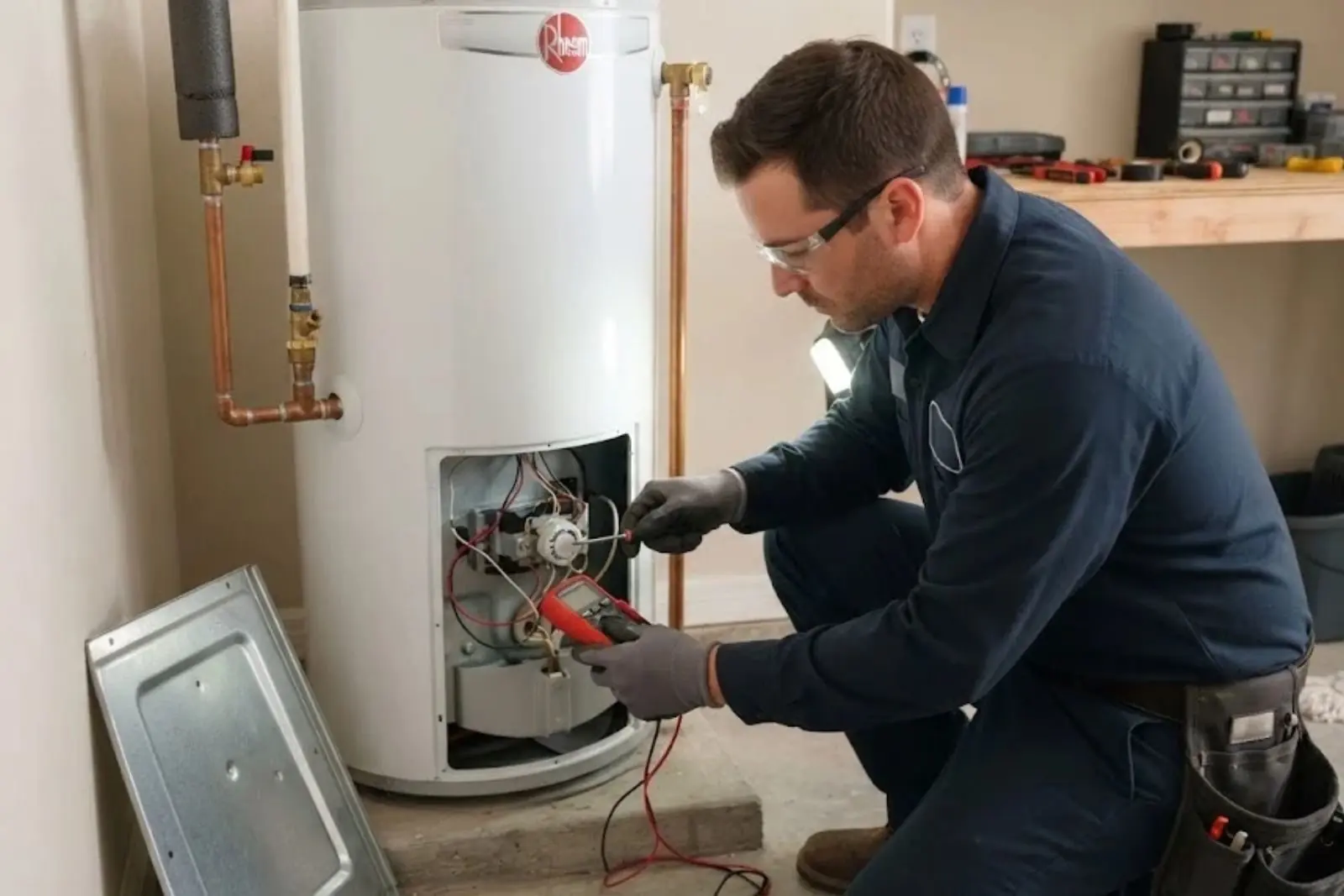
What the tank does and why it fails quietly
Heating water makes it expand. On an open system the extra volume pushes back into the city main and nobody notices. On a closed system, where a check valve or pressure reducing valve blocks that path, the extra volume has nowhere to go, and pressure jumps every time the burner or element fires.
An expansion tank is a small steel vessel with an air cushion on one side of a rubber diaphragm. Water moves into the other side as it expands, then drains back out as it cools. That is the whole job.
So here is the short answer. If your heater sits on a closed system, you want a working tank, and a failed one should be replaced rather than ignored. It fails quietly because hot water keeps coming, while the fittings and the relief valve take the punishment.
Signs the tank may have failed
Several of these look like other problems, so treat the list as a place to start looking, not a diagnosis.
| What you notice | What it often means | What to do |
|---|---|---|
| Relief valve drips after a heating cycle | Pressure is spiking past the valve setting | Check the tank. Do not cap or plug the valve |
| Pipes thump or hammer when the heater fires | Sudden pressure change, or a loose pipe strap | Check the tank, then the pipe supports |
| Water comes out of the tank's air valve | Diaphragm has ruptured | Replace the tank |
| Tank feels full and heavy all over | Air cushion is gone | Test the air side, or replace |
| Rust streaks at the stem or the threads | Slow leak or an aging vessel | Replace before it lets go |
| Faucets spit or run harder after the heater cycles | Pressure swings at the fixtures | Check the tank and the pressure reducing valve |
A safe way to check it yourself
You do not need tools beyond a flashlight and a small screwdriver, and you never need to open anything that holds hot water.
Find the tank
It hangs from the cold supply line near the heater, often blue, gray or white, and usually about the size of a football or a small keg. It has a tire-style valve on the bottom or the top.
Look before you touch
Check for rust, drips or a puddle on the floor beneath it. A wet base or crusty stem means stop here and call.
Tap the shell
A healthy tank sounds hollow near the air side and dull near the water side. If it thuds from top to bottom, the air cushion is probably gone.
Press the valve stem briefly
A small puff of air is normal. A spray of water means the diaphragm has failed and the tank is done.
Replace, recharge, or leave it alone
A tank that has only lost air, with an intact diaphragm, can sometimes be recharged. The air side has to be set to match your house pressure, and that reading is only accurate with the water side shut and drained down. Guessing with a tire pump can leave the tank too soft or too hard.
Once water comes out of the valve stem, recharging will not help. The diaphragm is torn and the tank should be replaced. The new one needs to be sized to the heater volume, matched to the house pressure, and supported so it does not hang on the threads alone.
Leaving it alone is reasonable only on an open system, where the tank was never doing anything. That is a judgment made by looking at the valves on the incoming line, not by looking at the tank.
[[tel|Call (206) 864-6558]] and we can set up a same-day appointment when available.
A dripping relief valve is a warning
The temperature and pressure relief valve is the last safety device on the heater. If it drips, something is pushing past its limit. Never plug it, cap it, or tighten it shut, and never run a tube from it to a place where it cannot be seen.
A one-time drip right after a hot shower is a different story from a steady one. If the drip repeats, call before the valve wears out and starts leaking constantly. See our water heater repair page for the other things that can trip that valve.
When to stop and call us
Some jobs belong to a licensed and insured plumber. These are the ones.
- Water from the tank valve. The diaphragm is torn. Replace the tank.
- A steady drip from the relief valve. Find the cause before the valve fails open.
- Rust or wet threads at the tank. The fitting can let go under pressure.
- A heater old enough to be on its way out. Replace the tank with the heater. See water heater replacement for that decision.
- Any smell of gas near the heater. Leave the building, call the gas utility or 911, then call us.
- Water pooling on the floor. Shut the cold supply to the heater and call (206) 864-6558.
What this means in Mountlake Terrace
Inside city limits the City of Mountlake Terrace supplies the water, and the supply side often runs through a pressure reducing valve or a backflow device where it enters the house. Those parts can close the system. If one is on your incoming line, an expansion tank is how the heater's extra volume gets somewhere to go, so a failed tank is worth fixing rather than ignoring.
This is earthquake country. A heater should be strapped to the wall framing, and the tank hanging off its cold line adds weight to a threaded fitting. Ask that the tank be braced, and that the strap check happens on the same visit, so one shake does not snap the connection and drain the heater onto the floor.
Expansion tank questions we hear
On a closed system, no. The pressure that tank was absorbing will climb on every heating cycle and load the heater, the relief valve, the supply stops and every fixture.
On an open system the tank may never have been needed. A technician can tell which you have by looking at the valves on the incoming line.
Look at the cold water line coming into the house. A check valve, a backflow device, or a pressure reducing valve with a built-in check can make the system closed. If you are not sure, a technician can read the fittings in a few minutes.
No. A worn valve seat, sediment on the seat, or a tank running too hot can also make it drip. The expansion tank is one suspect, so check it before replacing the valve, because a new valve will keep dripping if pressure is the cause.
Usually yes if it is the same age or you see rust at the stem or a wet base. A new heater on an old tank with a dead diaphragm starts life under the same pressure spikes. We can look at both during the same visit. We also dispatch to the neighboring city, so a plumber in Lynnwood is covered the same way.
That depends on your lease, but a failing tank is a property issue, not a tenant repair. Tell your landlord about the dripping valve or the thumping pipes. If the property manager prefers, we can talk with them directly about what we found.
Strapping holds the tank of the heater, not the small vessel hanging off the cold line. Ask for the tank to be supported by a bracket or a rigid pipe so it does not stress the fitting during a shake.
Standards and sources
These public references sit behind the rules and checks this page mentions.