
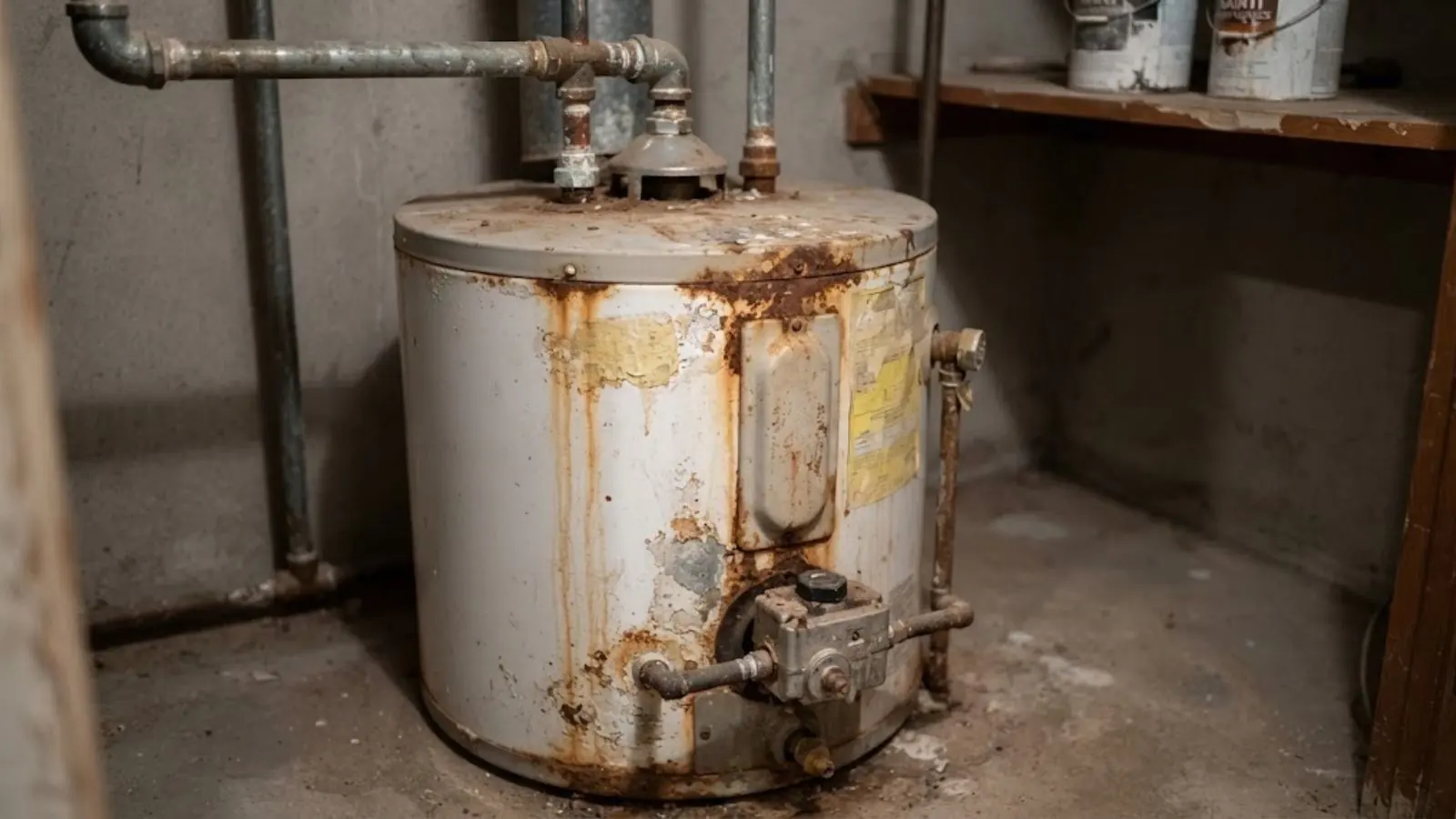
Fix the part or retire the tank
Replace the water heater when the tank itself is leaking. Repair it when a replaceable part has failed and the tank is dry and sound. Age and repeat failures settle the cases in between.
The tank is a steel shell with a glass-like lining. Once water works through a rusted seam or a failed weld, no part swap can seal it. A bad thermostat, heating element, igniter, thermocouple or T&P valve is different. Those parts come out and go in without touching the tank.
If you cannot tell which side you are on, call (206) 864-6558 and describe what you see. Our dispatcher can usually tell a part problem from a tank problem by the symptoms, and we give a clear price before work starts.
Symptoms sorted by likely outcome
Use this as a first sort. A technician still needs to look before anyone commits to either path.
| What you see | What it usually means | Lean toward |
|---|---|---|
| Water pooled under the tank, wet bottom seam | The tank shell has failed | Replace |
| Electric unit, no hot water at all | Failed heating element, thermostat or tripped high-limit switch | Repair |
| Gas unit keeps going out | Dirty burner, weak thermocouple or flame sensor, or a gas control problem | Repair |
| Steam or drips from the discharge pipe | Worn T&P valve, or pressure running high from a failed expansion tank | Repair |
| Rust-colored hot water only | Spent anode rod and a lining under attack | Depends on age |
| Rumbling or popping when heating | Sediment baked onto the bottom of the tank | Flush if young, replace if old |
| Hot water runs out fast | Failed lower element, heavy sediment, or a unit too small for the household | Repair first |
Call (206) 864-6558 and tell the dispatcher what you see at the heater. We will say whether it sounds like a part or a tank.
Reading the age off the label
Age is the tiebreaker, so find it before you decide anything. The data plate sits on the side of the tank near the top. The serial number usually carries the month and year of manufacture, and each maker publishes a decoder.
Many tank heaters reach the end of their useful life somewhere around a decade, sometimes a little longer when the anode rod was replaced on schedule. Past that mark, a repair often buys a short stretch before the next failure shows up.
A young heater with a failed part is a repair almost every time. An old heater with a failed part is a judgment call, and the question to ask is how many more months of trouble-free service the repair would realistically buy.
Signs it is the tank and not a part
Wipe every fitting dry first, then watch the unit for an hour. These clues point at the shell.
- Wet at the bottom seam. Moisture on the pan or floor with dry pipe fittings above it.
- Rust streaks on the jacket. Orange trails running down the outside of the tank.
- Hot water that stays rusty. The color does not clear after the line runs for a few minutes.
- A rotted drain pan. Soft, stained or collapsing material under the heater.
- Repeat visits. A different failure every few months on a unit that is already old.
- Rumbling that returns. Noise comes back soon after a flush on an aging tank.
What a repair can and cannot buy
Replacing an anode rod, flushing sediment and swapping an expansion tank can extend the life of a younger heater. Past about a decade, the lining has usually been attacked already, and a new rod rarely reverses that.
Spend repair money on parts that protect the tank, not on parts that sit beside a tank that is already failing.
If you replace, fix what caused the failure
A heater that died early may have been hurt by the setup around it. Closed plumbing systems can push pressure up when the water heats, and a missing or waterlogged expansion tank lets that pressure beat on the tank and the T&P valve.
Replacement is the time to check the discharge pipe, the supply stops, the venting on a gas unit, and the strapping that holds the tank to the wall. We also cover plumbing calls in neighboring Lynnwood, and the same checks apply there.
While you wait for the technician
A few steps limit the damage and speed up the visit.
If the tank is leaking, turn the cold supply valve at the heater clockwise until it stops.
For an electric unit, switch off its breaker only if the floor around the panel is dry and safe.
A clear picture of the label lets us read age, size and fuel type before we arrive.
Move boxes and stored items so there is room to work and a clear path to the unit.
Write down where the water appeared and when the hot water changed.
When to stop and call right away
Some situations are not a decide-later call. If you smell gas, leave the building and call the gas utility or 911 first, then call us. If water is spraying, the tank is bulging, or there is water near an electrical panel or outlet, do not touch anything and keep people away.
Scalding water at the tap, or steam from the discharge pipe, also needs a prompt visit. Our line is open at any hour, and you can read how water heater repair works while you wait.
What this means in Mountlake Terrace
Mountlake Terrace grew from a former landing field, and the first homes were compact two-bedroom houses built from 1949. Many were later renovated and expanded. A heater in an expanded home can sit far from the bathrooms it feeds, or in a closet that was framed around an older unit. Those details change how simple a swap is, so tell the dispatcher where your heater lives.
Replacement can involve a permit. The city permit center at City Hall lists building, electrical, mechanical and plumbing permit types, but permit rules vary, so ask the city permit center before the work starts. The number is 425-776-1161. Settle early who files the paperwork, because a rushed swap on a cold morning is when that question gets skipped.
Questions homeowners ask before deciding
Look for the data plate on the side of the tank near the top. It lists a serial number, and most makers build the month and year of manufacture into it.
Search the brand name plus serial number decoder to read it. If the plate is painted over or missing, a photo of the unit is enough for us to estimate the age on the phone.
It depends on the gap between repairs and the age of the tank. A second repair on a young unit is usually a sound bet. A second or third repair on a unit past its decade mark often means the next failure is close, so replacement starts to make more sense.
Not necessarily. Water at the top often comes from a loose supply connection, a failed fitting or the T&P valve discharge. Those are repairs. Water that seeps from the bottom seam or runs down the jacket points to the tank shell, and that means replacement.
Your lease and your landlord decide. Tell the landlord or property manager as soon as you see water or lose hot water. We can talk with the property manager directly, explain what we found, and give a clear price before any work starts.
Permit rules vary, so ask the city permit center before the work starts. The center is at City Hall, 23204 58th Ave W, and the number is 425-776-1161. Ask your plumber who files the paperwork so nobody assumes the other party did.
Often yes, but it changes the job. Moving from tank to tankless affects gas line size, venting, electrical supply and the space on the wall. Call (206) 864-6558 and we will talk through what your setup would need.
Standards and sources
These public references sit behind the rules and checks this page mentions.